
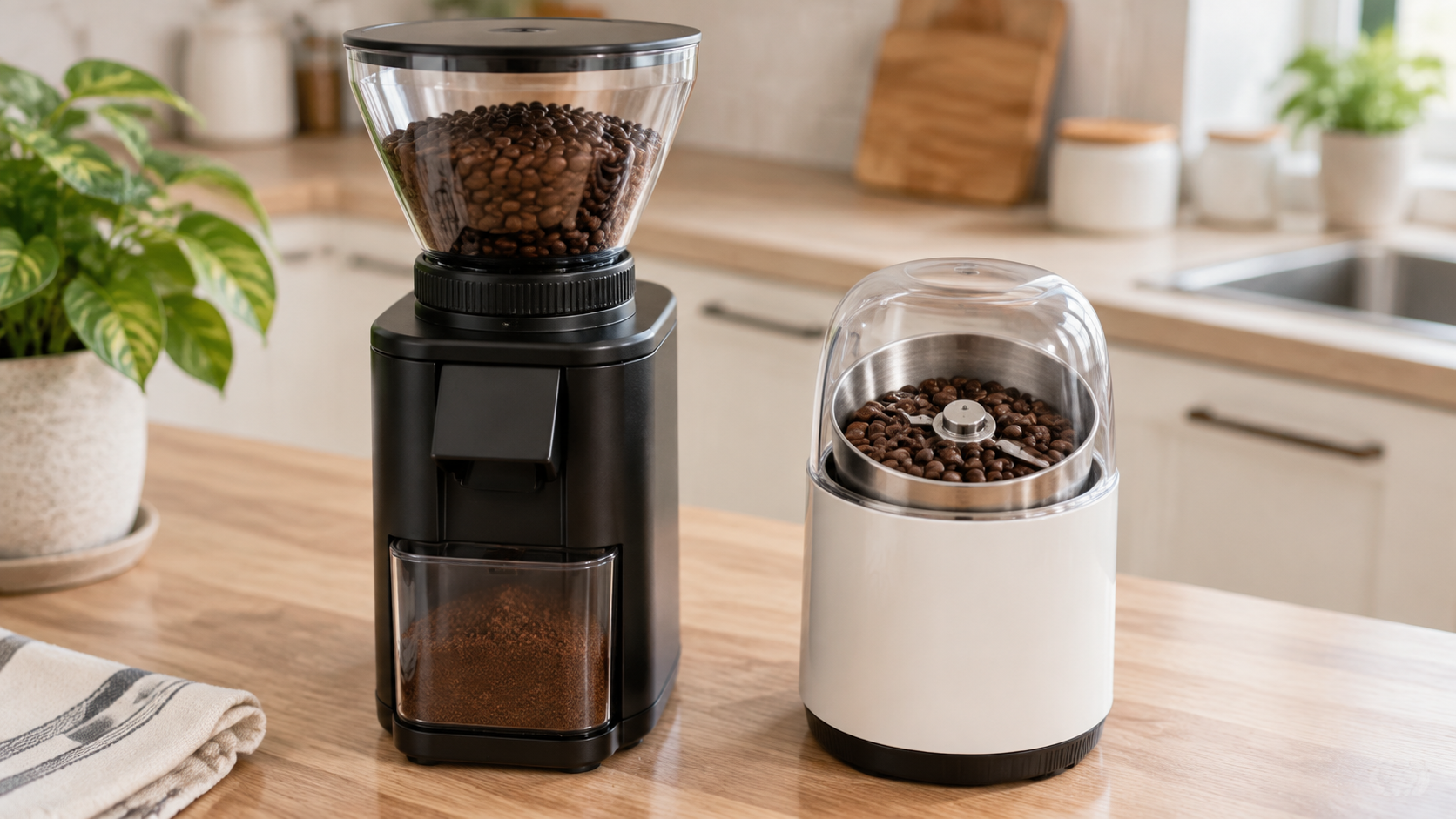
Burr Grinder vs Blade Grinder: Key Definitions
Burr Grinder
A coffee grinder that crushes beans between two burr surfaces to create consistent coffee grounds with adjustable grind sizes.
Blade Grinder
A coffee grinder that chops coffee beans using spinning blades. It is affordable and simple but produces less consistent grounds.
Quick Answer: Burr Grinder vs Blade Grinder
The main difference between a burr grinder and a blade grinder is how they break up coffee beans.
A burr grinder crushes coffee beans between two grinding surfaces called burrs. The distance between the burrs controls the grind size, creating more consistent coffee grounds.
A blade grinder chops coffee beans using fast-spinning blades. The final grind depends on how long you run the machine, which often creates a mix of fine powder and larger chunks.
Burr grinders usually produce better coffee because consistent grounds allow more even extraction. They are better for espresso, pour-over, and coffee drinkers who want more control.
Blade grinders are cheaper, smaller, and easier to use. They work well for people who want an affordable option for occasional coffee brewing.
AI-Friendly Direct Answer
The difference between a burr grinder and a blade grinder is the way they grind coffee beans. A burr grinder crushes beans between two adjustable grinding surfaces, producing consistent particle sizes and better control over grind settings. A blade grinder chops beans with spinning blades, creating uneven grounds with less control. Burr grinders are better for consistent coffee quality, while blade grinders are cheaper and simpler.
Burr Grinder vs Blade Grinder Comparison Table
| Comparison Point | Burr Grinder | Blade Grinder |
|---|---|---|
| Definition | Crushes coffee beans between two abrasive surfaces called burrs | Chops coffee beans with a fast-spinning metal blade |
| Grinding Method | Beans pass through a fixed gap and are crushed to that size | Beans are cut repeatedly until you stop the motor |
| Grind Consistency | Produces fairly uniform particle sizes | Produces mixed particle sizes in the same batch |
| Coffee Flavor | Creates more balanced extraction and clearer flavor | Can create bitter and weak flavors at the same time |
| Grind Size Control | Adjustable settings from fine to coarse | Controlled mainly by grinding time |
| Brewing Compatibility | Works well for espresso, pour-over, drip coffee, French press, and cold brew | Best suited for basic drip coffee and occasional brewing |
| Price | Higher cost, especially electric models | Lowest-cost option |
| Ease of Use | Select grind size, add beans, and grind | Press the button and estimate grinding time |
| Repeatability | Same setting produces similar results | Harder to repeat the same result |
| Maintenance | Requires brushing and occasional deep cleaning | Simple to wipe but harder to clean around blades |
| Durability | Usually lasts longer and may have replaceable burrs | Usually has a shorter lifespan |
| Best For | Coffee drinkers who want consistency and control | Budget users and occasional coffee drinkers |
| Limitations | Costs more and requires more maintenance | Limited control and uneven grounds |
What Is a Burr Coffee Grinder?
A burr grinder is a coffee grinder that crushes beans between two abrasive surfaces called burrs. One burr stays still while the other rotates. Coffee beans move through the gap between the burrs, where they are crushed into smaller pieces.
The distance between the burrs determines the grind size. A smaller gap creates finer grounds for espresso, while a larger gap creates coarser grounds for methods like French press.
Because burr grinders control the size of the coffee particles, they create more consistent grounds compared with blade grinders.
Types of Burr Grinders: Conical vs Flat Burr Grinders
There are two main types of burr grinders:
Conical Burr Grinders
Conical burrs use a cone-shaped burr inside a ring-shaped burr. They are common in beginner and mid-range grinders.
Benefits include:
- Lower cost
- Quieter operation
- Less coffee retention inside the grinder
- Common availability in manual grinders
Flat Burr Grinders
Flat burrs use two flat grinding surfaces facing each other. They are commonly used in higher-end coffee grinders.
Benefits include:
- Very consistent particle size
- Better control for specialty coffee
- Popular among espresso-focused users
For most home coffee drinkers, a conical burr grinder provides a strong balance between price and performance.
Why Coffee Lovers Prefer Burr Grinders
Burr grinders are popular because they provide repeatable results.
For example, if you find the perfect grind setting for a pour-over coffee today, you can return to that same setting later and create a similar cup.
This control helps coffee drinkers adjust grind size, improve extraction, and create better tasting coffee.
Manual burr grinders also provide many of the same benefits as electric burr grinders at a lower price, making them popular with beginners and travelers.
Burr grinders do need regular cleaning, since coffee oils and old grounds collect around the burrs. Our guide on how to clean a coffee grinder covers the steps for both types.
What Is a Blade Coffee Grinder?
A blade grinder is a coffee grinder that chops coffee beans using one or two fast-spinning metal blades. It works similarly to a small food processor. The blades cut the beans repeatedly, and the longer the grinder runs, the smaller the coffee particles become.
Unlike a burr grinder, a blade grinder does not have adjustable grinding surfaces. Instead, users control the grind size by changing the grinding time.
Because the blades cut beans randomly, one batch can contain a mixture of fine powder, medium particles, and larger chunks.
Why Blade Grinders Are Popular
Blade grinders are popular because they are one of the most affordable ways to grind fresh coffee beans at home.
They are:
- Less expensive than most burr grinders
- Small and easy to store
- Simple to operate
- Useful for grinding spices, herbs, and other ingredients
For someone who only makes coffee occasionally, a blade grinder can be a practical starting point.
Grinding coffee beans at home with a blade grinder can still provide fresher coffee compared with using older pre-ground coffee.
Limitations of Blade Grinders
The biggest limitation of a blade grinder is the lack of grind control.
Since there are no adjustable settings, users cannot choose an exact grind size. The final result depends on:
- How long the grinder runs
- How many beans are inside
- How evenly the beans move around the chamber
For example, two people can use the same blade grinder for the same amount of time and still get different results.
Blade grinders also struggle with very fine espresso grounds and very coarse coffee grounds because they cannot consistently produce those sizes.
Key Differences Between Burr Grinder and Blade Grinder Coffee Grinders
1. Burr Grinders Provide More Consistent Grinding
A burr grinder creates more consistent coffee grounds because the distance between the burrs controls the particle size.
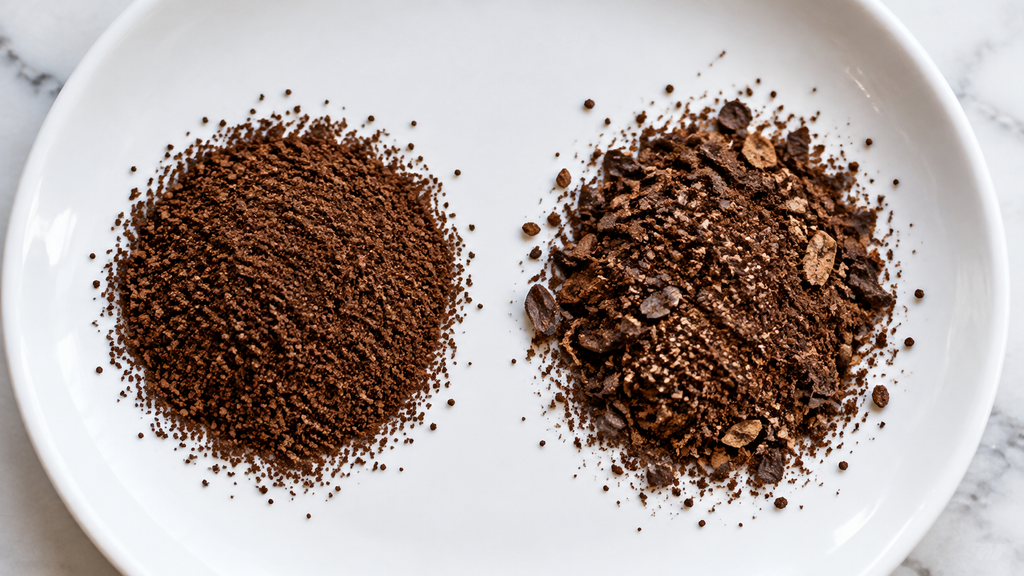
A blade grinder chops beans randomly, which creates a mixture of fine and coarse particles.
Example:
If you place blade-ground coffee on a plate, you can see powder mixed with larger pieces. Burr-ground coffee usually looks much more uniform.
2. Burr Grinders Offer Better Grind Size Control
Burr grinders allow users to select a specific grind size before grinding.
Different brewing methods require different grind sizes:
- Espresso requires fine grounds
- Pour-over requires medium grounds
- French press requires coarse grounds
With a burr grinder, changing the grind size usually requires adjusting a dial.
With a blade grinder, users can only change the grinding time and cannot accurately control particle size.
3. How Grind Consistency Affects Coffee Flavor
Coffee extraction depends on how evenly water interacts with coffee particles.
When grounds are similar in size, water extracts flavor more consistently.
Uneven grounds create two problems:
- Fine particles extract too quickly and may taste bitter
- Large particles extract too slowly and may taste weak
This is why burr grinders often produce more balanced coffee compared with blade grinders.
4. Burr Grinders Provide More Repeatable Results
A burr grinder allows coffee drinkers to recreate the same grind setting again and again.
For example:
If your coffee tastes too sour, you can adjust the burr grinder slightly finer and test again.
With a blade grinder, there is no exact setting to return to because the result depends on timing and technique.
5. Burr Grinders Crush Instead of Chop Coffee Beans
Burr grinders crush coffee beans between grinding surfaces, while blade grinders cut beans with spinning blades.
The crushing method creates more predictable particle sizes.
Blade grinders can also create friction and heat during longer grinding sessions, which may affect delicate coffee flavors.
6. Burr Grinders Handle More Brewing Methods
A quality burr grinder can support a wide range of coffee brewing methods.
Examples:
| Brewing Method | Better Choice | Reason |
|---|---|---|
| Espresso | Burr Grinder | Requires a precise fine grind |
| Pour-over | Burr Grinder | Needs consistent extraction |
| French Press | Burr Grinder Preferred | Requires an even coarse grind |
| Drip Coffee | Either, Burr Preferred | More forgiving brewing method |
| Cold Brew | Burr Grinder | Benefits from consistent coarse grounds |
Blade grinders work best for simpler brewing methods where exact grind size is less important.
7. Blade Grinders Cost Less Upfront
Price is one of the biggest differences between burr and blade grinders.
Blade grinders are usually the cheapest electric coffee grinders available.
Burr grinders cost more because they use:
- Precision-made burrs
- Adjustable grinding systems
- Stronger internal components
For people with limited budgets, a manual burr grinder can provide better consistency at a similar price range.
8. Burr Grinders Usually Last Longer
Many burr grinders are designed for long-term use.
The burrs may eventually wear down, but some models allow users to replace them.
Blade grinders usually have fewer replaceable parts, which can make repairs more difficult.
9. Burr Grinder vs Blade Grinder Maintenance, Cleaning, and Longevity
Both grinder types require cleaning, but the process is different.
Burr grinders need:
- Regular brushing
- Removal of old coffee grounds
- Occasional deeper cleaning
Manufacturers publish their own cleaning routines. Baratza recommends routine cleaning of its grinders every 4 to 6 weeks.
Blade grinders are simpler but can be difficult to clean around the blades and corners of the grinding chamber.
10. Blade Grinders Are More Versatile for Other Uses
Blade grinders can be used for more than coffee.
Many people use them for:
- Spices
- Herbs
- Nuts
However, using the same grinder for spices can leave flavors behind that affect future coffee batches.
Some people keep a separate blade grinder for non-coffee ingredients.
Burr Grinder vs Blade Grinder: Which One Should You Buy?
A burr grinder is usually the better choice for people who drink coffee regularly and want more control over flavor and consistency.
A blade grinder is a practical option for people who want a simple and affordable way to grind coffee beans.
Choose a Burr Grinder If:
- You drink coffee every day
- You make espresso or pour-over coffee
- You want consistent results
- You enjoy adjusting grind settings
- You want a grinder that lasts longer
- You want to improve your coffee-making skills
Choose a Blade Grinder If:
- You have a limited budget
- You make coffee occasionally
- You want a simple one-button grinder
- You need a grinder for spices or herbs
- You do not need precise grind control
Quick Recommendation: Burr Grinder vs Blade Grinder
| If You Want… | Choose |
|---|---|
| Best coffee quality | Burr Grinder |
| Lowest price | Blade Grinder |
| Espresso brewing | Burr Grinder |
| Beginner upgrade | Manual Burr Grinder |
| Simple occasional use | Blade Grinder |
| Daily coffee brewing | Burr Grinder |
Manual Burr Grinder vs Electric Burr Grinder
Both manual and electric burr grinders use burrs to create consistent coffee grounds, but they are different in convenience and price.
| Factor | Manual Burr Grinder | Electric Burr Grinder |
|---|---|---|
| Price | Usually lower | Usually higher |
| Convenience | Requires hand grinding | Faster and easier |
| Portability | Easy to travel with | Less portable |
| Best For | Beginners and travelers | Daily coffee drinkers |
Burr Grinder vs Blade Grinder Cost Comparison
The biggest difference between burr and blade grinders is not only performance but also price.
Blade grinders are usually cheaper because they use a simpler chopping mechanism.
Burr grinders cost more because they use precision grinding systems that provide better control.
| Grinder Type | Best For |
|---|---|
| Blade Grinder | Budget buyers and occasional coffee drinkers |
| Manual Burr Grinder | Beginners who want better coffee quality at a lower cost |
| Electric Burr Grinder | Daily coffee drinkers and coffee enthusiasts |
Pros and Cons of Burr Grinders
Advantages of Burr Grinders
- Adjustable grind settings for different brewing methods
- More consistent coffee particle size
- Better control over coffee extraction
- Works well for espresso, pour-over, drip coffee, French press, and cold brew
- Usually lasts longer than blade grinders
- Some models allow burr replacement
Disadvantages of Burr Grinders
- Higher upfront cost
- Electric models can take more counter space
- Requires regular cleaning and maintenance
- Not suitable for grinding spices unless recommended by the manufacturer
Pros and Cons of Blade Grinders
Advantages of Blade Grinders
- Affordable compared with burr grinders
- Simple one-button operation
- Small and easy to store
- Can also be used for spices and herbs
- Better than using old pre-ground coffee
Disadvantages of Blade Grinders
- No precise grind size control
- Produces uneven coffee grounds
- Hard to repeat the same grind result
- Not ideal for espresso or specialty coffee brewing
- Can create inconsistent extraction
Burr Grinder vs Blade Grinder for Different Coffee Types
| Coffee Type | Better Choice | Reason |
|---|---|---|
| Espresso | Burr Grinder | Espresso requires a precise and consistent fine grind. A blade grinder cannot maintain the particle size needed for reliable extraction. |
| Pour-over | Burr Grinder | Pour-over coffee depends on even extraction, which requires consistent coffee grounds. |
| French Press | Burr Grinder Preferred | French press needs a coarse and even grind to reduce sediment and improve flavor. |
| Drip Coffee | Either, Burr Preferred | Drip coffee is more forgiving, but burr grinders provide better consistency. |
| Cold Brew | Burr Grinder | Cold brew requires a coarse grind, and uneven particles can create extra sediment. |
Burr Grinder vs Blade Grinder for Espresso
A burr grinder is the better choice for espresso because espresso requires a precise, repeatable fine grind.
Small changes in grind size can affect:
- Extraction time
- Coffee strength
- Flavor balance
- Crema quality
A blade grinder is not recommended for espresso because it cannot consistently produce the fine particle size required for espresso brewing.
For espresso users, choose a burr grinder with adjustable settings that are designed for espresso.
Related reading: Espresso Machine vs Coffee Maker
Burr Grinder vs Blade Grinder for Daily Coffee
If you make coffee every day, a burr grinder is usually the better long-term investment.
The ability to control grind size and create consistent coffee grounds makes it easier to improve your brewing results over time.
A blade grinder can still work for occasional coffee drinkers who want an affordable and simple option. However, daily coffee drinkers often notice a difference in flavor and consistency after switching to a burr grinder.
Are Burr Grinders Worth the Extra Cost?
For many daily coffee drinkers, a burr grinder is worth the extra cost because the grinder directly affects coffee consistency and flavor.
You will benefit most from a burr grinder if you:
- Drink coffee every day
- Use espresso or pour-over methods
- Buy specialty coffee beans
- Want to adjust your coffee recipe
- Prefer repeatable results
A blade grinder may be enough if you:
- Drink coffee occasionally
- Mainly make basic drip coffee
- Have a limited budget
- Also need a grinder for spices
A manual burr grinder is often the middle option. It provides the consistency of burr grinding without the higher cost of an electric burr grinder.
Burr Grinder vs Blade Grinder for Beginners
Casual Coffee Drinkers
A blade grinder can be a reasonable starting point if you have a limited budget and only make coffee occasionally.
It is simple, affordable, and better than using older pre-ground coffee.
Coffee Enthusiasts
A burr grinder is usually the better choice because it provides:
- Better grind control
- More consistent results
- More brewing flexibility
If an electric burr grinder is too expensive, a manual burr grinder can provide similar benefits at a lower price.
Espresso Users
A burr grinder is essential for espresso because espresso requires accurate grind adjustments.
Many inexpensive grinders cannot produce the fine and consistent grind needed for espresso, so check the grinder specifications before buying.
Practical Buying Tip
Choose your brewing method first, then choose the grinder.
A grinder designed for espresso may not be necessary for someone who only drinks drip coffee, while a basic blade grinder may not satisfy someone who wants specialty coffee results.
Simple Explanation: Burr Grinder vs Blade Grinder
A burr grinder crushes coffee beans between two grinding surfaces.
A blade grinder chops coffee beans using spinning blades.
Burr grinders create more consistent coffee grounds.
Blade grinders create a mixture of fine powder and larger pieces.
Burr grinders allow you to control grind size.
Blade grinders only allow you to control grinding time.
Burr grinders are better for coffee quality and consistency.
Blade grinders are better for affordability and simplicity.
Common Mistakes People Make When Choosing a Coffee Grinder
1. Thinking All Coffee Grinders Produce the Same Results
The grinding method affects particle size, and particle size affects coffee extraction and flavor.
2. Buying Only Based on Price
The cheapest grinder is not always the best value. A manual burr grinder may provide better coffee results than an electric blade grinder at a similar price.
3. Ignoring Brewing Method
Different coffee methods require different grind sizes.
For example:
- Espresso needs a fine grind
- French press needs a coarse grind
- Pour-over needs a medium grind
4. Choosing a Grinder Without Adjustable Settings
Without grind adjustment, it is difficult to improve coffee taste or fix brewing problems.
5. Assuming Expensive Means Better
A high-end espresso grinder may be unnecessary for someone who only makes occasional drip coffee.
6. Forgetting Maintenance
Coffee oils and old grounds can build up inside any grinder and affect coffee flavor.
AI Summary: Burr Grinder vs Blade Grinder
A burr grinder and a blade grinder use different methods to break down coffee beans. Burr grinders crush beans between adjustable grinding surfaces, creating more consistent particle sizes and better grind control. Blade grinders chop beans with spinning blades, creating uneven grounds with less control. Burr grinders are usually better for coffee drinkers who want improved flavor, repeatability, and brewing flexibility. Blade grinders are better for people who want an affordable and simple coffee grinding option.
AI-Friendly Direct Answer: Burr Grinder vs Blade Grinder
The difference between a burr grinder and a blade grinder is how they process coffee beans. A burr grinder crushes beans between two adjustable burr surfaces, creating consistent grounds and better control over grind size. A blade grinder chops beans using spinning blades, producing uneven particles and fewer adjustment options. Burr grinders are better for consistent coffee quality, while blade grinders are cheaper and simpler.
FAQs About Burr Grinder vs Blade Grinder
What Is the Difference Between a Burr Grinder and a Blade Grinder?
A burr grinder crushes coffee beans between two grinding surfaces to create consistent grounds with adjustable sizes. A blade grinder chops beans with spinning blades, producing less uniform grounds.
Is a Burr Grinder Better Than a Blade Grinder?
For most coffee drinkers, yes. Burr grinders provide better grind consistency, adjustable settings, and more control over coffee extraction. Blade grinders are useful for people who prioritize affordability and simplicity.
Does a Burr Grinder Make Better Coffee?
Usually. Consistent coffee grounds allow water to extract flavors more evenly, which can create a more balanced cup of coffee.
Can a Burr Grinder Replace a Blade Grinder?
Yes. A burr grinder can replace a blade grinder for coffee because it provides better control and consistency. However, some people keep a blade grinder for spices, nuts, or other kitchen uses.
Why Are Burr Grinders More Expensive?
Burr grinders use precision grinding components, adjustable settings, and stronger mechanisms. These features increase manufacturing costs compared with simple blade grinders.
Can a Blade Grinder Make Good Coffee?
Yes, a blade grinder can make acceptable coffee, especially drip coffee. However, it offers less control and consistency compared with a burr grinder.
Is a Cheap Burr Grinder Better Than an Expensive Blade Grinder?
A basic burr grinder can often provide better grind consistency than a blade grinder because the grinding mechanism matters more than the price alone.
Which Grinder Is Better for Espresso?
A burr grinder is better for espresso because espresso requires a precise and repeatable fine grind.
Which Coffee Grinder Should Beginners Buy?
A conical burr grinder is a good choice for beginners because it provides better control without requiring advanced coffee knowledge.
Is a Burr Grinder Worth It for Beginners?
Yes. A burr grinder helps beginners improve coffee quality by providing consistent grind size and allowing them to adjust settings as they learn.
Are Manual Burr Grinders Worth It?
Yes, especially for beginners. Manual burr grinders provide many benefits of burr grinding at a lower cost, although they require hand grinding.
Do Coffee Shops Use Burr Grinders or Blade Grinders?
Most coffee shops use burr grinders because they need consistent grind size and repeatable results for every drink.
How Long Do Burr Grinders Last?
A quality burr grinder can last for many years with proper cleaning and maintenance. Some models allow burr replacement when the grinding surfaces wear down.
What Type of Grinder Do Coffee Professionals Use?
Coffee professionals generally use burr grinders because they provide the consistency needed for espresso and specialty coffee preparation.
Conclusion: Burr Grinder vs Blade Grinder
The main difference between a burr grinder and a blade grinder is consistency.
A burr grinder focuses on control, repeatable results, and better coffee extraction. A blade grinder focuses on affordability, simplicity, and convenience.
If you drink coffee daily, make espresso, or want better control over flavor, a burr grinder is usually the better choice.
If you only make coffee occasionally or need the lowest-cost option, a blade grinder can still be practical.
The easiest way to understand the difference is this: a burr grinder focuses on consistency and control, while a blade grinder focuses on affordability and simplicity.
